 Add to Chrome
 Add to Firefox
 Add to Edge
Enhancing LLM Metacognition via Cognitive Pairwise Training
May 30, 2026
Reinforcement learning with verifiable rewards (RLVR) has become central to LLM reasoning, but its outcome-level rewards can make models more willing to give confident answers when evidence or reasoning is unreliable. Existing SFT or RL methods mainly teach LLMs to refuse or express uncertainty at the response level, which can overfit abstention behavior rather than improve reasoning reliability. To address this limitation, we propose Cognitive Pairwise Training (CPT), a cognitive mid-training alignment stage that turns pairwise comparisons over reasoning traces into a reusable alignment signal. By learning to distinguish trustworthy from flawed reasoning, CPT encourages the model to internalize a reasoning-quality discrimination boundary rather than memorize surface refusal patterns. Across five model scales and three model families, CPT improves the reasoning--metacognition trade-off. At 14B, CPT+RL outperforms the standard SFT+RL pipeline by +2.2 math-average points and +5.2 abstention-F1 points. Further analyses show that CPT improves trace quality and exhibits strong robustness and scalability across evaluation and training settings. Code and models are released at https://github.com/Tsinghua-dhy/CPT.

Personalized Turn-Level User Conversation Satisfaction Benchmark
May 28, 2026User satisfaction with AI assistants is highly personalized: the same response may satisfy one user but disappoint another depending on what each user expects and what they have asked for before. Existing automatic evaluation methods mostly measure generic response quality, making it difficult to judge whether a response satisfies a user at a specific turn. We study this problem as personalized turn-level user conversation satisfaction evaluation. We build a conversation satisfaction evaluator that combines compact user memories with target-turn context to produce satisfaction scores and dissatisfaction-oriented rationales. Meta-evaluation against human satisfaction annotations shows that personalized memory and post-hoc score calibration improve ordinal agreement and dissatisfied-turn detection over supervised, retrieval-based, and generic LLM-as-a-judge baselines. We further introduce PersTurnBench, a personalized turn-level user conversation satisfaction benchmark that uses the verified evaluator to assess generation models via replay. By holding the replay state fixed, PersTurnBench enables controlled comparison of generic generation models and memory-augmented personalized systems without new human labels for every candidate model. The evaluator and benchmark let researchers compare candidate generation models on personalized satisfaction without collecting new user feedback for every model.
TheraAgent: Self-Improving Therapeutic Agent for Precise and Comprehensive Treatment Planning
May 07, 2026Formulating a treatment plan is inherently a complex reasoning and refinement task rather than a simple generation problem. However, existing large language models (LLMs) mainly rely on one-shot output without explicit verification, which may result in rough, incomplete, and potentially unsafe treatment plans. To address these limitations, we propose TheraAgent, an agentic framework that replaces one-shot generation with an iterative generate-judge-refine pipeline. By mirroring the actual reasoning process of human experts who iteratively revise treatment plans, our framework progressively transforms coarse and incomplete drafts into precise, comprehensive, and safer therapeutic regimens. To facilitate the critical judge component, we introduce TheraJudge, a treatment-specific evaluation module integrated into the inference loop to enforce clinical standards. Experiments show TheraAgent achieves state-of-the-art results on HealthBench, leading in Accuracy and Completeness. In expert evaluations, it attains an 86% win rate against physicians, with superior Targeting and Harm Control. Moreover, the highly agreement between TheraJudge and HealthBench evaluations confirms the reliability of our framework.
APAO: Adaptive Prefix-Aware Optimization for Generative Recommendation
Mar 03, 2026Generative recommendation has recently emerged as a promising paradigm in sequential recommendation. It formulates the task as an autoregressive generation process, predicting discrete tokens of the next item conditioned on user interaction histories. Existing generative recommendation models are typically trained with token-level likelihood objectives, such as cross-entropy loss, while employing multi-step beam search during inference to generate ranked item candidates. However, this leads to a fundamental training-inference inconsistency: standard training assumes ground-truth history is always available, ignoring the fact that beam search prunes low-probability branches during inference. Consequently, the correct item may be prematurely discarded simply because its initial tokens (prefixes) have low scores. To address this issue, we propose the Adaptive Prefix-Aware Optimization (APAO) framework, which introduces prefix-level optimization losses to better align the training objective with the inference setting. Furthermore, we design an adaptive worst-prefix optimization strategy that dynamically focuses on the most vulnerable prefixes during training, thereby enhancing the model's ability to retain correct candidates under beam search constraints. We provide theoretical analyses to demonstrate the effectiveness and efficiency of our framework. Extensive experiments on multiple datasets further show that APAO consistently alleviates the training-inference inconsistency and improves performance across various generative recommendation backbones. Our codes are publicly available at https://github.com/yuyq18/APAO.
Don't Miss the Forest for the Trees: In-Depth Confidence Estimation for LLMs via Reasoning over the Answer Space
Nov 18, 2025Knowing the reliability of a model's response is essential in application. With the strong generation capabilities of LLMs, research has focused on generating verbalized confidence. This is further enhanced by combining chain-of-thought reasoning, which provides logical and transparent estimation. However, how reasoning strategies affect the estimated confidence is still under-explored. In this work, we demonstrate that predicting a verbalized probability distribution can effectively encourage in-depth reasoning for confidence estimation. Intuitively, it requires an LLM to consider all candidates within the answer space instead of basing on a single guess, and to carefully assign confidence scores to meet the requirements of a distribution. This method shows an advantage across different models and various tasks, regardless of whether the answer space is known. Its advantage is maintained even after reinforcement learning, and further analysis shows its reasoning patterns are aligned with human expectations.
GSE: Evaluating Sticker Visual Semantic Similarity via a General Sticker Encoder
Nov 07, 2025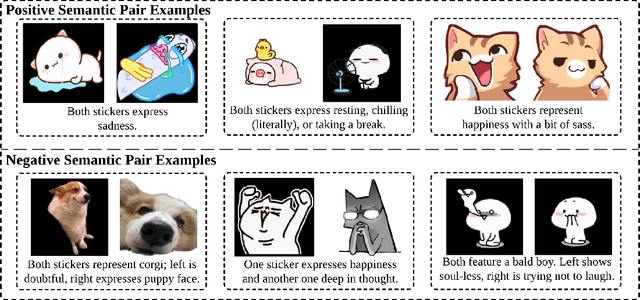
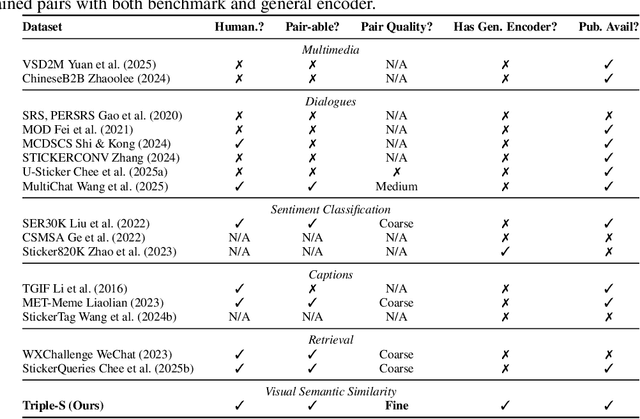
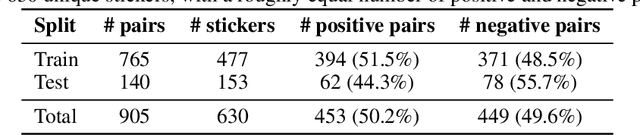
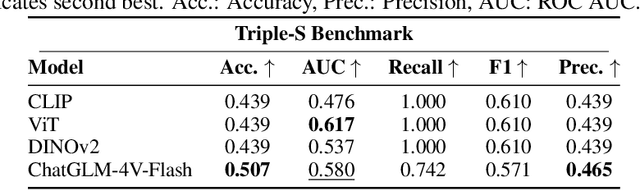
Stickers have become a popular form of visual communication, yet understanding their semantic relationships remains challenging due to their highly diverse and symbolic content. In this work, we formally {define the Sticker Semantic Similarity task} and introduce {Triple-S}, the first benchmark for this task, consisting of 905 human-annotated positive and negative sticker pairs. Through extensive evaluation, we show that existing pretrained vision and multimodal models struggle to capture nuanced sticker semantics. To address this, we propose the {General Sticker Encoder (GSE)}, a lightweight and versatile model that learns robust sticker embeddings using both Triple-S and additional datasets. GSE achieves superior performance on unseen stickers, and demonstrates strong results on downstream tasks such as emotion classification and sticker-to-sticker retrieval. By releasing both Triple-S and GSE, we provide standardized evaluation tools and robust embeddings, enabling future research in sticker understanding, retrieval, and multimodal content generation. The Triple-S benchmark and GSE have been publicly released and are available here.
Doctor-R1: Mastering Clinical Inquiry with Experiential Agentic Reinforcement Learning
Oct 05, 2025The professionalism of a human doctor in outpatient service depends on two core abilities: the ability to make accurate medical decisions and the medical consultation skill to conduct strategic, empathetic patient inquiry. Existing Large Language Models (LLMs) have achieved remarkable accuracy on medical decision-making benchmarks. However, they often lack the ability to conduct the strategic and empathetic consultation, which is essential for real-world clinical scenarios. To address this gap, we propose Doctor-R1, an AI doctor agent trained to master both of the capabilities by ask high-yield questions and conduct strategic multi-turn inquiry to guide decision-making. Our framework introduces three key components: a multi-agent interactive environment, a two-tiered reward architecture that separately optimizes clinical decision-making and communicative inquiry skills, and an experience repository to ground policy learning in high-quality prior trajectories. We evaluate Doctor-R1 on OpenAI's HealthBench and MAQuE, assessed across multi-facet metrics, such as communication quality, user experience, and task accuracy. Remarkably, Doctor-R1 surpasses state-of-the-art open-source specialized LLMs by a substantial margin with higher parameter efficiency and outperforms powerful proprietary models. Furthermore, the human evaluations show a strong preference for Doctor-R1 to generate human-preferred clinical dialogue, demonstrating the effectiveness of the framework.
UR$^2$: Unify RAG and Reasoning through Reinforcement Learning
Aug 08, 2025Large Language Models (LLMs) have shown remarkable capabilities through two complementary paradigms: Retrieval-Augmented Generation (RAG), which enhances knowledge grounding, and Reinforcement Learning from Verifiable Rewards (RLVR), which optimizes complex reasoning abilities. However, these two capabilities are often developed in isolation, and existing efforts to unify them remain narrow in scope-typically limited to open-domain QA with fixed retrieval settings and task-specific assumptions. This lack of integration constrains generalization and limits the applicability of RAG-RL methods to broader domains. To bridge this gap, we propose UR2 (Unified RAG and Reasoning), a general framework that unifies retrieval and reasoning through reinforcement learning. UR2 introduces two key contributions: a difficulty-aware curriculum training that selectively invokes retrieval only for challenging problems, and a hybrid knowledge access strategy combining domain-specific offline corpora with LLM-generated summaries. These components are designed to enable dynamic coordination between retrieval and reasoning, improving adaptability across a diverse range of tasks. Experiments across open-domain QA, MMLU-Pro, medical, and mathematical reasoning tasks demonstrate that UR2 (built on Qwen2.5-3/7B and LLaMA-3.1-8B) significantly outperforms existing RAG and RL methods, achieving comparable performance to GPT-4o-mini and GPT-4.1-mini on several benchmarks. We have released all code, models, and data at https://github.com/Tsinghua-dhy/UR2.
How Far Can LLMs Improve from Experience? Measuring Test-Time Learning Ability in LLMs with Human Comparison
Jun 17, 2025As evaluation designs of large language models may shape our trajectory toward artificial general intelligence, comprehensive and forward-looking assessment is essential. Existing benchmarks primarily assess static knowledge, while intelligence also entails the ability to rapidly learn from experience. To this end, we advocate for the evaluation of Test-time Learning, the capacity to improve performance in experience-based, reasoning-intensive tasks during test time. In this work, we propose semantic games as effective testbeds for evaluating test-time learning, due to their resistance to saturation and inherent demand for strategic reasoning. We introduce an objective evaluation framework that compares model performance under both limited and cumulative experience settings, and contains four forms of experience representation. To provide a comparative baseline, we recruit eight human participants to complete the same task. Results show that LLMs exhibit measurable test-time learning capabilities; however, their improvements are less stable under cumulative experience and progress more slowly than those observed in humans. These findings underscore the potential of LLMs as general-purpose learning machines, while also revealing a substantial intellectual gap between models and humans, irrespective of how well LLMs perform on static benchmarks.
StoryBench: A Dynamic Benchmark for Evaluating Long-Term Memory with Multi Turns
Jun 16, 2025Long-term memory (LTM) is essential for large language models (LLMs) to achieve autonomous intelligence in complex, evolving environments. Despite increasing efforts in memory-augmented and retrieval-based architectures, there remains a lack of standardized benchmarks to systematically evaluate LLMs' long-term memory abilities. Existing benchmarks still face challenges in evaluating knowledge retention and dynamic sequential reasoning, and in their own flexibility, all of which limit their effectiveness in assessing models' LTM capabilities. To address these gaps, we propose a novel benchmark framework based on interactive fiction games, featuring dynamically branching storylines with complex reasoning structures. These structures simulate real-world scenarios by requiring LLMs to navigate hierarchical decision trees, where each choice triggers cascading dependencies across multi-turn interactions. Our benchmark emphasizes two distinct settings to test reasoning complexity: one with immediate feedback upon incorrect decisions, and the other requiring models to independently trace back and revise earlier choices after failure. As part of this benchmark, we also construct a new dataset designed to test LLMs' LTM within narrative-driven environments. We further validate the effectiveness of our approach through detailed experiments. Experimental results demonstrate the benchmark's ability to robustly and reliably assess LTM in LLMs.